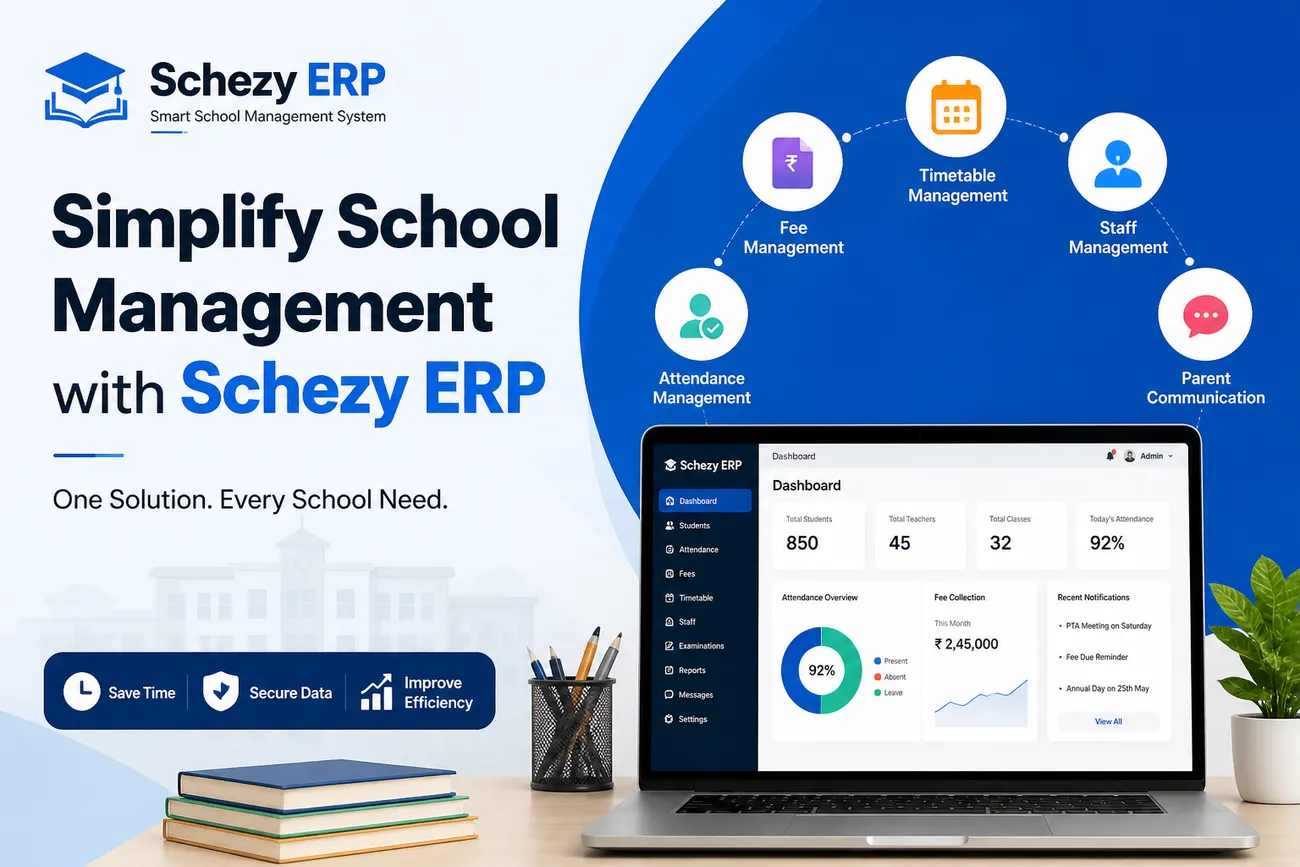
“How Schezy ERP Simplifies School Management and Administration”
Schezy ERP is a school management software that simplifies administrative tasks like attendance, fees, and communication, helping schools become more efficient and organized.
How Schezy ERP Simplifies School Management and Administration
Running a school is a job it is like managing a small city. There are a lot of things to take care of, like students, staff, parents, fees, schedules, exams, buses, libraries, stores and a lot of paperwork. I have seen administrators stuck in spreadsheets and teachers spending time updating records than teaching. That is why a good school management system is important.
In this post I will explain how Schezy ERP, a school management software helps schools simplify things. I will talk about what it does how it helps with problems common mistakes during implementation and practical steps to get the most out of it. If you are a principal, administrator or teacher looking for a school management system consider this a practical guide.
Why schools need a school ERP software now
Schools are under a lot of pressure they have to deal with rising expectations, tighter budgets and regulatory compliance. Many schools still use systems, like manual registers and separate tools for fees and exams. This creates a lot of duplication, slow processes and errors.
Schezy ERP brings all these pieces together. It is a digital platform that replaces paper forms, syncs student data and automates repetitive tasks. In my experience consolidating systems often delivers the results, like attendance and fee reconciliation becoming much faster and easier.
What is Schezy ERP?
Schezy ERP is a cloud-based school management system designed for schools. It combines student information system features with modules for finance, human resources, academic management, transportation, library and parent communication.
Schezy ERP works as a platform it means one source of truth for student records, role-based access for staff and real-time dashboards for leadership teams. For schools moving towards management Schezy fills those gaps without the complexity of big solutions.
Core modules that matter—what Schezy ERP includes
- Student Information System it stores info, enrollment history, health records and special needs.
- Admissions and Enquiries it digitizes the admissions workflow.
- Attendance and Biometric Integration it records attendance and syncs this data to protect against errors.
- Timetable and Substitution it builds master timetables and handles room conflicts.
- Examinations and Gradebook it configures grading scales. Publishes report cards.
- Fee Management and Online Payments it automates invoicing and reconciliations.
- HR and Payroll it manages staff profiles and payroll calculations.
- Transport and Route Management it plans routes. Allocates students to buses.
- Library and Inventory it tracks books and stock levels.
- Parent and Student Portal it provides real-time access to attendance, homework and fees.
- Analytics and MIS Reports it provides -built dashboards and customizable reports.
How Schezy ERP solves everyday pain points
schezy ERP solves pain points, like manual fee reconciliation, fragmented student data, teacher overload during exams and communication gaps with parents. It automates invoicing sends reminders and reconciles payments. It consolidates student data. Enforces validation rules. It streamlines exam scheduling and mark entry. It sends push notifications, SMS and emails to parents.
Security, privacy, and compliance
Security, privacy and compliance are important Schezy ERP follows role-based access control. Maintains encrypted data. It supports consent tracking and data export requests. It keeps audit logs that help during inspections or compliance reviews.
Integration and interoperability
Integration and interoperability are also important Schezy ERP offers APIs and connectors. It integrates with accounting software, payroll systems and payment gateways. It automates journal entries. Pushes payroll numbers to third-party providers.
Deployment and implementation—what to expect
Deploying and implementing Schezy ERP is a project it requires a planned rollout. It is important to define goals map existing processes and plan data migration. It is also important to pilot and phase the rollout provide user training and decide on a support model.
Common mistakes and how to avoid them
Common mistakes to avoid are skipping stakeholder buy-in, over-customization data hygiene, neglecting training and unrealistic timelines. It is important to engage representatives from every user group, streamline processes invest time in cleansing and validating records provide refresher sessions and plan timelines.
Return on investment—how Schezy pays back
The return on investment how Schezy ERP pays back is in time savings, improved collections, reduced errors, better teacher productivity and data-driven decisions. It automates attendance, reports and fee processes reducing time. It improves cash flow. Reduces arrears. It reduces reconciliation work and audit findings. It eases tasks allowing teachers to focus on teaching. It provides dashboards that help with budgeting and academic interventions.
To make the return, on investment pick a few key performance indicators like average time to publish a report card, percentage of online fee payments and daily attendance capture rate. Track these metrics. Compare them at regular intervals.
Real-life scenarios: practical examples
Let me give a couple of scenarios that show Schezy ERP in action.
Scenario 1: From chaotic fee office to organized finance hub. A sized school had a chaotic fee office with parents queuing for receipts and the finance officer spending days reconciling bank statements. After implementing Schezy ERPs fee module invoices were auto-generated parents paid online and the system reconciled transactions automatically. The finance office went from reconciliation every weekend to a once-a-week audit check.
Scenario 2: Faster exam cycles and clearer reporting. In one school I worked with teachers had to record marks and compile report cards by hand in formats. Schezys gradebook made assessments the same across subjects. Teachers entered marks into templates the system calculated averages and grades. The principal could run reports that compared performance instantly. Parents got report cards through the portal the same day marks were finalized.
Best practices to get the most out of Schezy ERP
The software is only as good as how you use it. These best practices will help you get the value from Schezy ERP:
- Start small and scale fast: try it out with one department fix any issues then use it for the whole school.When you get things at the start people get excited.
- Create super-users: train a staff members really well. They can help others. Be the first point of contact for support.
- Use the codes and names: use the same class codes, fee heads and staff IDs so you do not get confused later.
- Automate routine messages: set up reminders for fees alerts for attendance and notices for events so you do not have to send them
- Use dashboards every day: encourage heads of department and finance to look at KPI dashboards every morning. When you have data you can make small changes that help
How Schezy supports teachers
- Easy record-keeping for attendance and assessments.
- Quick access to student profiles and learning plans, including education needs.
- Shared lesson planning and resource scheduling to avoid conflicts.
- Automated messages to parents about homework, events and behavior. Teachers have more time to teach. From what I have seen teachers adopt systems faster when they see they can save time and have tools for the classroom. So prioritize what teachers need during the setup phase.
Parent engagement—why it matters and how Schezy helps
Parents want to know what is going on. They want to know when their child missed school what homework is due and whether fees are due. Schezys parent portal and mobile app help with this. Push notifications deliver updates like bus delays or weather-related closures. Regular updates. Attendance, assignment deadlines, progress. Keep parents involved which helps students do better.
One practical tip: encourage parents to register and verify their contact details when they enroll their child. It saves headaches later when you need to send alerts.
Scaling from small schools to larger institutions
Schezy ERP fits schools of all sizes. Small schools often use it to automate functions. Billing, attendance and communications. Larger institutions use modules like multi-campus management, advanced reporting and detailed access control.
Scalability is not about the number of users. Think about how complicated your processesre multi-shift timetables, transport fleets and centralized finance across branches. Schezy supports these scenarios with configuration so you can add features as your needs grow.
Cost considerations and pricing transparency
Cost is a concern for everyone. Pricing models are different. Some vendors charge per student others per module or per user. When you are evaluating Schezy or any ERP for schools look beyond the sticker price. Consider:
- Setup costs: moving data, training and initial configuration.
- Integration costs: APIs and third-party connectors if needed.
- Ongoing. Hosting fees.
In my experience the true cost of not implementing an ERP. Time lost, errors, missed revenues. Often exceeds subscription fees within the year. Still make sure you budget for the setup phase so the platform gets configured correctly from the start.
Measuring success after go-live
Measuring how well it works after launch is critical. Without it you will struggle to prove value. Set goals and monitor them regularly. Here are metrics that work well:
- Average time to complete a report card.
- Fee collection. Days sales outstanding.
- Daily attendance capture percentage.
- Teacher time spent on tasks.
- Parent portal adoption rate.
Migration tips: avoid the data trap
Data migration is where many projects go wrong. For a transition follow these steps:
- List all data sources.
- Standardize formats: dates, class names, fee heads.
- Validate fields: student IDs, parent contacts, bank details.
- Run test. Reconcile summaries before final migration.
- Keep a read- archive of legacy data for compliance purposes if needed.
Training and change management
Technology alone will not change behavior. Change management matters. Here is a practical training plan I have used:
- Role-based sessions: sessions for finance, admin, teachers and leadership so each group learns features relevant to their work.
- Hands-on labs: real tasks, not slides. Create invoices enter marks run a report.
- Quick reference guides: one-page job aids for common tasks.
- Open office hours: drop-in sessions for the first month after go-live.
- Feedback loops: collect user feedback and prioritize fixes or enhancements.
Future trends: what to expect in school ERP software
Final thoughts—practical next steps
If you are considering Schezy ERP or similar school management systems start by identifying your operational headaches. Pick a project with ROI. Fee automation or attendance digitization are good candidates. Run a pilot focus on data hygiene and make sure you allocate time for training and change management.
In my experience schools that treat ERP implementation as a process. Not just a software purchase. See the best results. They unlock time reduce errors. Improve communication, across the whole school community.
Helpful Links & Next Steps
Schezy