Why Digital Homework Systems Improve Student Accountability?
Digital homework systems are transforming how students manage their assignments and responsibilities. Unlike traditional paper-based homework, digital platforms provide clear instructions, set deadlines, and automated reminders in one organized space. This reduces confusion and helps students stay on track, encouraging better time management and consistent study habits.
One of the biggest benefits is transparency. Students can easily see pending tasks, completed work, and feedback, which creates a stronger sense of ownership over their learning. Teachers gain real-time visibility into submissions and performance, allowing them to provide timely support when needed. Parents can also stay informed, creating a collaborative environment around the student.
By improving organization, communication, and accountability, digital homework systems help students develop discipline, responsibility, and confidence skills that extend far beyond the classroom.
Why Digital Homework Systems Improve Student Accountability
Assigning homework used to be simple: hand out a worksheet, collect it next period, give a grade. Those days are gone. The moment we moved assignments online, a new set of possibilities opened up — and with them, a clearer path to student accountability.
In this post I’ll walk through why digital homework systems make it easier to hold students accountable, what features actually matter, and how schools can avoid common implementation pitfalls. I’ve worked with teachers and administrators who were skeptical at first, and I’ve seen the change happen when the right platform gets in place. If you're evaluating an online homework platform or school homework management system, this guide will help you focus on the real benefits — and what to watch for.
What we mean by "accountability" in the digital classroom
Accountability isn't just about catching cheaters or taking attendance. In the context of a digital classroom, student accountability means:
- Clear expectations — students know what’s due and when.
- Visible progress — teachers, students, and parents can see where work stands.
- Timely feedback — students get actionable comments that guide improvement.
- Responsible habits — submissions and revision systems encourage follow-through.
Digital homework systems are tools that help make those elements visible and repeatable. Instead of relying on memory, hallway conversations, or stacks of paper, you get data: submission timestamps, attempt history, and progress reports. That data is what turns vague expectations into measurable outcomes.
Top reasons digital homework platforms boost accountability
Here are the main ways an online homework platform improves accountability — and why they matter to school administrators, principals, and EdTech decision-makers.
1. Automatic, timestamped submission records
One of the simplest yet most powerful features of student progress tracking software is timestamped submissions. When a student submits an assignment online, the system records the exact time. No more "I turned it in!" versus "I emailed it late" arguments.
In my experience, just having that record drastically reduces disputes over late work. Teachers can set clear policies (e.g., 10% penalty per day late) and apply them consistently. That consistency builds trust and fairness — two essential pieces of accountability.
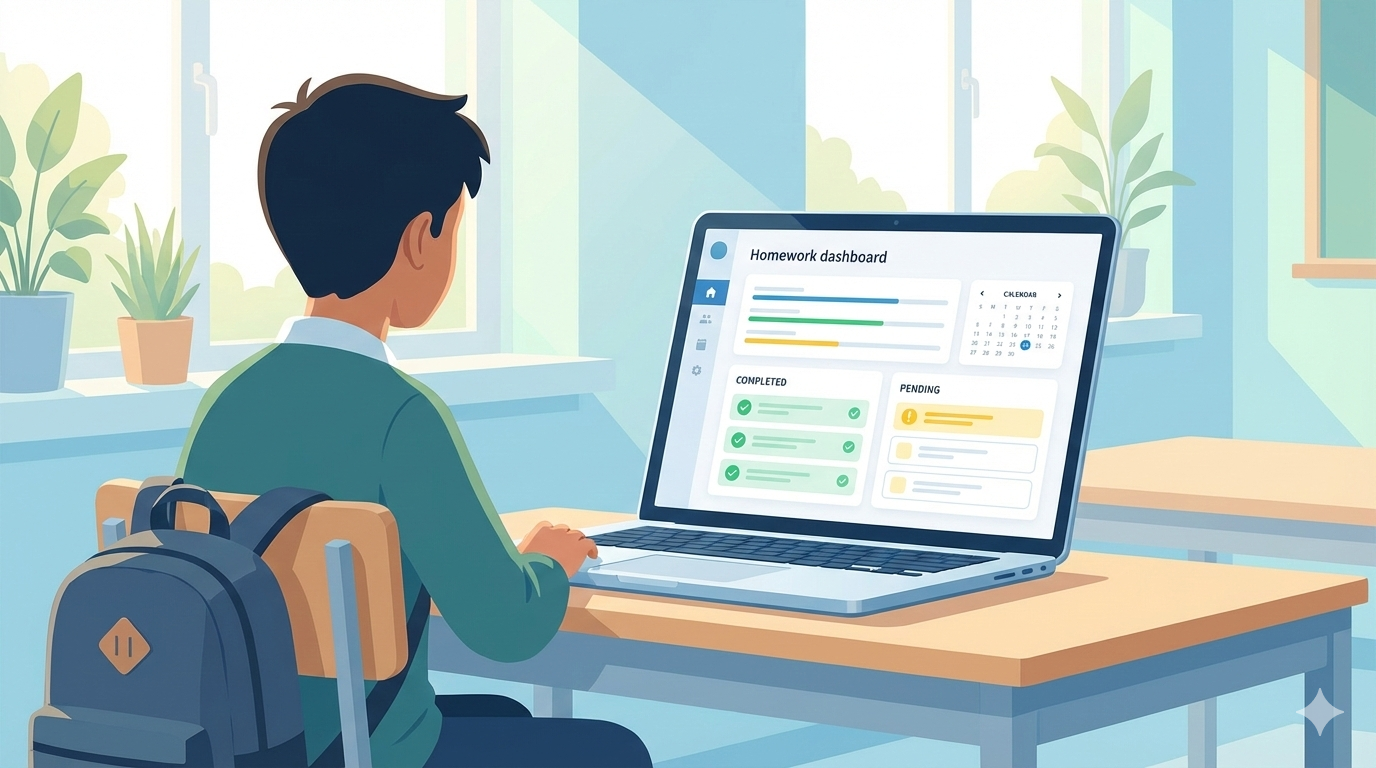
2. Real-time progress dashboards
Digital classroom tools provide dashboards that show who's completed tasks, who's started but not finished, and who hasn't engaged at all. These dashboards give teachers and administrators a snapshot they can act on immediately.
For example, a math teacher I worked with used a homework tracking system to identify students who consistently began assignments but never moved past the first attempt. That pattern pointed to a learning gap rather than laziness, prompting targeted interventions (small-group sessions and scaffolded assignments) that raised completion rates.
3. Instant, actionable feedback
Feedback is where accountability turns into learning. When students get quick, specific feedback — whether automated grading for objective questions or teacher comments for open responses — they can adjust before misconceptions calcify.
Digital platforms speed up this loop. Auto-graded quizzes give students immediate correctness checks. Rubrics within the platform help teachers grade consistently and give students clear reasons for their scores. That immediacy fosters a growth mindset: students rely less on cramming and more on iterative improvement.
4. Parent and guardian visibility
Accountability is a three-way street when parents are involved. Many school homework management systems let families view assignments, deadlines, and grades. This keeps everyone aligned and reduces surprises at report card time.
I’ve noticed schools that enable parent accounts see fewer “I didn’t know” excuses and more family-supported study routines. It doesn’t replace teacher-parent communication, but it does streamline it.
5. Integration with existing systems (SIS, LMS)
Digital homework systems that sync with your Student Information System (SIS) or Learning Management System (LMS) reduce double work and errors. Grades and attendance flow where they need to, so accountability measures are grounded in accurate records.
When data isn’t siloed, administrators can run meaningful reports — for example, correlating homework completion with standardized assessment scores. That kind of analysis informs resource allocation and instruction improvements.
6. Adaptive assignments and mastery tracking
Digital systems can deliver adaptive assignments that meet students where they are. Instead of one-size-fits-all homework, platforms can provide differentiated tasks that help students master standards at their own pace.
Mastery tracking turns completion into competence. Students aren’t just checked off for turning something in; they work toward demonstrated proficiency. That shift changes the conversation from "Did they do it?" to "Did they learn it?" — a more meaningful measure of accountability.
Key features that drive accountability — what to look for
Not all digital homework systems are created equal. If you’re evaluating platforms, here are the features that actually move the needle on accountability.
- Timestamps and attempt history: Essential for fair late work policies and intervention planning.
- Real-time dashboards: Teacher and admin views that highlight at-risk students and missing work.
- Commenting and rubric support: Enables consistent, actionable feedback for open-ended assignments.
- Parent/guardian portals: Increases transparency and engages families in the learning process.
- Integration with SIS/LMS: Avoids double entry and ensures gradebook integrity.
- Mobile-friendly interfaces: Many students and parents rely on phones; a clunky mobile experience reduces engagement.
- Analytics and reporting: Cohort-level insights help principals and coordinators spot trends and allocate supports.
- Plagiarism and originality checks: Helpful, but more about academic integrity than accountability per se. Still worth having.
Choosing the right blend of features depends on your school's needs. Small schools might prioritize ease of use and parent access. Districts typically need robust reporting and SIS integration. In my experience, the platform's flexibility and support model often matter more than a checklist of features.
How digital homework improves transparency — and why that matters
Transparency is a major accountability lever. When assignments, grading criteria, and deadlines are visible and consistent, expectations become shared rather than assumed.
Consider grading rubrics. On paper, rubrics get lost or rewritten. In a digital homework system, rubrics live with the assignment. Students can see exactly how their work will be evaluated before they start. Teachers use the same rubric for every student, which reduces grade variance and complaints.
Transparency also helps administrators. During teacher evaluations or curriculum reviews, reviewers can quickly see assignment quality, feedback patterns, and alignment with standards. That makes professional development more targeted and less guesswork-driven.
Concrete gains: accountability metrics to track
If you're rolling out an education technology solution for homework, track these metrics to evaluate accountability impact:
- Homework completion rate (by class, grade, and school)
- Timely submission rate (on-time vs. late)
- Average number of attempts per assignment (shows persistence or confusion)
- Feedback turnaround time (lag between submission and teacher feedback)
- Grade variance before and after rubrics (consistency indicator)
- Parent portal activation and login frequency
- Correlation between homework completion and assessment performance
These KPIs show whether the system is improving accountability or just digitizing old practices. For instance, if completion rates rise but assessment scores don't, the issue might be assignment quality rather than student effort.
Implementation tips — what to do (and avoid)
Rolling out a digital homework system is more than buying software. It’s a change-management process. Here are practical tips from schools I’ve worked with.
Start small and iterate
Don't flip every class to the new system at once. Pilot with a few teachers across different subjects. Gather feedback, fix workflows, and refine policies before scaling. Small pilots let you test integrations (SIS/LMS), grading syncs, and parent communication strategies.
Train teachers on workflow — not just features
I've seen training sessions that teach teachers how to click buttons but not how to redesign assignments for the platform. Focus on workflow: creating assignments, attaching rubrics, giving feedback, and using analytics for interventions.
Offer lesson-level examples. Show how a long-form essay can be scaffolded into checkpoints with interim feedback. That concrete modeling reduces resistance and raises fidelity.
Define clear late-work and feedback policies
Consistency is everything. When your digital homework system provides timestamps and logs, administrators should set clear, school-wide policies: What counts as late? How many days for feedback? How will multiple attempts be recorded?
Make those policies visible in the platform so students and parents see them with every assignment.
Engage parents early
Send a welcome email that explains the parent portal, basic navigation, and how homework visibility works. Offer short video walkthroughs for families with limited tech experience.
It’s not enough to give them access. Show them how to use it to support their child (viewing due dates, checking feedback, contacting teachers).
Avoid common pitfalls
- Over-automation: Automating everything can strip nuance from feedback. Keep teacher comments for formative tasks.
- Poor assignment design: Digitizing busywork doesn’t improve learning. Use platform features (scaffolds, adaptive items) to make homework meaningful.
- Ignoring data: Vendors may offer dashboards; if you don't review them, you're missing the point. Make analytics part of routine staff meetings.
Common questions decision-makers ask — answered
Will a digital homework system make teachers' workload worse?
Short answer: not if you implement it well. Automated grading for objective items actually reduces time spent on low-level corrections. The catch: teachers need time to learn the tools and redesign assignments to take advantage of automation.
In my experience, teachers initially spend more time setting up digital assignments but save time in the long run — especially if they use rubrics, templates, and banked questions.

How do we prevent academic dishonesty?
Digital platforms can reduce cheating through multiple means: randomized questions, time windows, originality checks, and analytics that flag suspicious patterns (e.g., identical answers across students).
Still, technology isn't a silver bullet. Combine platform features with assessment design best practices: open-response items, project-based tasks, and oral defenses where appropriate.
Is parent access a privacy concern?
Parent portals should comply with local privacy laws (FERPA in the U.S., for example). Most vendors provide role-based access and audit logs. Work with your vendor and IT team to set appropriate permissions and communicate them clearly to families.
Real-world examples: what success looks like
Below are condensed examples of how schools used digital homework systems to improve accountability. These are anonymized but reflect real patterns I've seen.
Suburban middle school — improving on-time submission rates
Problem: On-time homework submissions hovered around 60%. Teachers spent class time chasing missing work.
Intervention: The school adopted a homework tracking system with parent portals and automatic reminders. Teachers set up short, daily formative tasks to reinforce classroom learning.
Result: On-time submissions rose to 85% in a semester. Parents reported they appreciated the reminders and clearer rubrics. Teachers used analytics to pull small cohorts for reteach sessions, reducing whole-class repetition.
Urban high school — linking homework to mastery
Problem: Students completed assignments but performed poorly on state assessments.
Intervention: An adaptive homework platform replaced generic problem sets. Assignments adjusted to student performance and tracked mastery of standards.
Result: Completion rates remained steady, but assessment scores improved as students worked on targeted skills. Teachers used mastery reports to justify in-class interventions and reassign practice for students who needed it.
Small rural district — reducing grading time
Problem: Teachers spent weekends grading stacks of papers.
Intervention: The district introduced an online homework platform that supported auto-graded items and rubric grading for essays. Teachers collaborated to build question banks aligned to standards.
Result: Average grading time per assignment dropped by 30%, freeing teachers to provide more individualized feedback and plan differentiated instruction.
Measuring ROI for digital homework systems
School leaders want to know: is this investment worth it? Here’s a framework to quantify return on investment (ROI).
- Time savings: Calculate average teacher hours saved on grading and administrative tasks.
- Improved outcomes: Track changes in assessment scores, credit recovery rates, or graduation rates that correlate with platform use.
- Efficiency gains: Include savings from reduced paper use and streamlined communications.
- Family engagement: Measure parent portal adoption and its impact on chronic absenteeism or missing work.
Combine these data points into a multi-year projection. Often the human benefits — less teacher burnout, more targeted instruction — are the hardest to quantify but are the real long-term value.
Checklist: questions to ask vendors
When you're vetting digital homework systems for your district or school, use this quick checklist to guide demos and RFP responses:
- How does the platform record submissions and attempts? Can we export logs?
- What integration options exist for our SIS/LMS? Is SSO supported?
- Are analytics configurable? Can we create custom reports for grades, completion, and mastery?
- What parent engagement features exist, and how do they handle privacy/permissions?
- Does the platform support offline or low-bandwidth scenarios?
- How is data backed up and secured? What compliance frameworks are followed?
- What professional development and onboarding support do you provide?
- Can we pilot with a subset of teachers and scale? What does success look like for similar districts?
Don't be shy about asking for references from similar districts; hearing concrete outcomes from peers is invaluable.
Making homework meaningful — design tips for teachers
Accountability improves when assignments are worth doing. Here are simple design principles teachers can use right away.
- Keep assignments short and purposeful: Five targeted problems beat a 20-question worksheet most of the time.
- Use formative checkpoints: Break larger tasks into submission checkpoints to build momentum and make feedback actionable.
- Mix item types: Combine auto-graded questions for practice with an occasional low-stakes written reflection to check reasoning.
- Leverage rubrics: Make criteria transparent so students know what success looks like before they begin.
- Offer revision opportunities: Let students resubmit after feedback. This incentivizes effort and models real-world improvement.
These practices, supported by a good platform, change homework from a compliance task into an intentional part of learning.
Final thoughts: accountability is cultural, not just technological
Technology can make accountability visible, equitable, and actionable, but it’s not a substitute for leadership and clear expectations. The platform is a tool; success depends on policies, professional development, and a culture that values timely feedback and student growth.
From my view, schools that treat digital homework systems as part of a broader strategy — not a quick fix — get the most out of them. Set clear policies, invest in teacher training, engage families, and use analytics to inform instruction. Do these things, and you'll see homework move from a paperwork chore to a strategic lever for student success.
Helpful Links & Next Steps
If you're curious about how a digital homework platform can work in your school, Book a Free Demo with Schezy to see real-time progress tracking, homework management workflows, and reporting features in action. I’d recommend starting with a short pilot — it’s the best way to see whether a digital classroom tool will improve accountability without disrupting your teachers’ day-to-day work.